ICT VS SMC
1. What ICT and SMC Actually Are
ICT
A complete institutional trading framework
Includes: liquidity theory, market structure, time, dealing ranges, PD arrays, session models
Highly rule-based, top-down, narrative driven
SMC
A simplified derivative of institutional concepts
Focuses mainly on: structure, liquidity, order blocks
Less emphasis on time, narrative, and inter-market logic
Think of SMC as a subset of ICT.
2. Core Elements of ICT
Market Structure
Market Structure Shift (MSS)
Break of Structure (BOS)
Internal vs External structure
Dealing range
Premium / Discount (50% equilibrium)
Liquidity Theory
Buy-Side Liquidity (BSL)
Sell-Side Liquidity (SSL)
Liquidity sweeps / stop raids
Inducement
Draw on liquidity
Price Delivery (PD Arrays)
Order Blocks (OB)
Fair Value Gaps (FVG)
Inversion FVG (IFVG)
Balanced Price Range (BPR)
Breaker Blocks (BB)
Rejection Blocks (RB)
Hidden Blocks (HB)
Price Action Logic
Displacement
Expansion vs consolidation
Balanced vs imbalanced price delivery
Mitigation
Time & Sessions (Major ICT Difference)
Asia / London / New York sessions
Kill zones
Time-based highs/lows
Daily / weekly / monthly profiles
Execution Framework
Multi-timeframe alignment (HTF → LTF)
Entry models (Judas swing, power of three, etc.)
Risk rules
Narrative bias
3. Core Elements of SMC
Market Structure
BOS
CHoCH (Change of Character)
Higher Highs / Higher Lows
Trend vs range
Liquidity
Equal highs / lows
Liquidity grabs
Stop hunts
Inducement (less formalized)
Key Levels
Order Blocks
Supply / Demand zones
Premium / Discount zones (sometimes used)
Price Action
Impulse vs correction
Consolidation
Break and retest logic
Execution
Structure-based entries
Partial multi-timeframe use
Less emphasis on time
4. Common Elements Between ICT and SMC (Overlap)
These are the true shared concepts — if someone trades SMC correctly, they are already trading partial ICT.
A. Liquidity (Core to Both)
Shared understanding:
Markets move to take liquidity
Highs/lows attract stops
Liquidity precedes reversals or continuation
Common tools:
Equal highs / lows
Stop runs
Liquidity sweeps
B. Market Structure
Shared concepts:
Trend definition via highs/lows
Break of Structure (BOS)
Shift in directional bias (MSS / CHoCH)
C. Order Blocks
Shared logic:
Institutional footprints
Zones of mitigation
Used as entry or reaction points
D. Premium / Discount
Shared logic:
Buy low, sell high
Mean reversion around equilibrium
Use of 50% of range (explicit in ICT, implicit in SMC)
E. Multi-Timeframe Analysis
Shared rules:
Higher timeframe defines bias
Lower timeframe used for execution
5. Key Differences (Important)
AreaICTSMCLiquidity TheoryDeep & preciseSimplifiedTimeCritical (sessions, kill zones)Mostly ignoredPD ArraysMany defined toolsFewNarrativeRequiredOptionalPrecisionInstitutionalRetail-adaptedExecutionRule-based modelsPattern-based
6. Why Traders Get Confused
Common misconceptions:
“SMC and ICT are the same” ❌
“Order blocks alone are enough” ❌
“Structure breaks = entries” ❌
“Indicators confirm smart money” ❌
Reality:
Liquidity → Structure → Displacement → Mitigation → Expansion
Both ICT and SMC follow this sequence.
ICT simply defines every step explicitly.
7. Minimal Unified Model (ICT + SMC)
If you want the simplest correct overlap model, use only:
Liquidity sweep (BSL / SSL)
MSS / CHoCH
Entry at OB or FVG
Trade from discount/premium
Target opposing liquidity
That is:
100% ICT compliant
100% SMC compliant
Keep reading
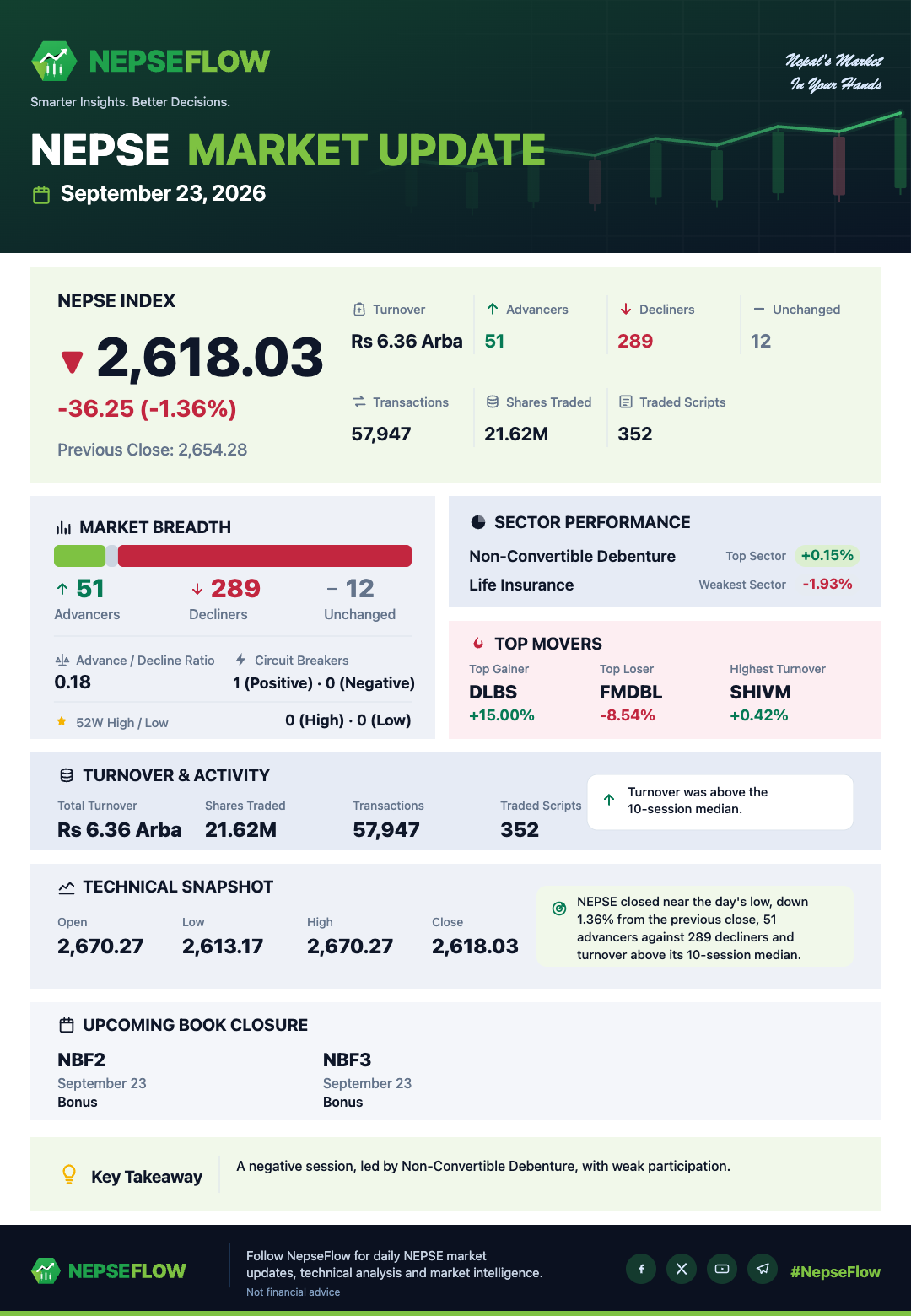 Daily recap
NEPSE closes -1.36 lower as breadth collapses to 51 advancers against 289 decliners
The market closed sharply lower, with the index at 2,618.03, a change of -36.25 or -1.36. Selling pressure was broad and one-sided: 51 stocks advanced while...
NEPSE closed higher at 2,654.28 on turnover that ran well above its recent median, though breadth narrowed sharply from the prior session.
The index finished the session at 2,654.28, a gain of +0.26%, with turnover rising to Rs 7.05 Arba — a reading that sits well above the trailing median and...
NEPSE closes higher at 2,647.22 as turnover rises and 228 stocks advance against 97 decliners.
The NEPSE index ended the session at 2,647.22, a gain of 22.85 points or +0.87% percent from the previous close of 2,624.37. The advance occurred on rising...